
Jammu and Kashmir AAP chief and MLA Mehraj Malik was detained under the Public Safety Act for allegedly disturbing public order in Doda district. The detention has sparked condemnation from opposition parties.
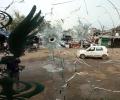
People in several districts of Punjab, Jammu and Kashmir and Gujarat spent an anxious night as authorities enforced blackouts amid heightened tension between India and Pakistan.

Incessant rains and flooding have caused widespread disruption in northern India, with states like Himachal Pradesh, Delhi, Punjab, and Jammu and Kashmir facing landslides, road closures, and displacement. Rescue efforts are underway as authorities grapple with the aftermath of the deluge.

Preliminary investigations into the accidental explosion that ripped through the Nowgam police station late Friday night, killing nine people, suggest that the use of excessive lighting by the forensic team may have triggered the massive blast, officials said Sunday.

Authorities have sealed three houses belonging to the affected families and shifted 21 their close relatives to government accommodation to be kept under strict monitoring.

A cloudburst in a remote village in Kathua district, Jammu and Kashmir, resulted in four fatalities and six injuries. Rescue operations are underway, and the district administration is monitoring the situation.
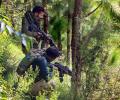
The soldiers, both commandos of an elite Para unit, went missing during a combing operation in the Kokernag area on Tuesday. The operation was launched two days ago in the Ahlan Gadole area, following inputs that a group of terrorists was hiding in the area, officials said.

Police in Faridabad continue their investigation into a suspected terror module after a large quantity of explosives was found in rented rooms. The probe is also examining potential links to a recent blast near Delhi's Red Fort.
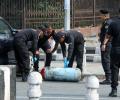
Indian authorities have uncovered a Jaish-e-Mohammad (JeM) terror plot involving doctors from south Kashmir, a Faridabad university, the recovery of 2,900 kg of explosives, and a car bomb near the Red Fort. Eight people have been arrested in connection with the plot.

Authorities in Jammu and Kashmir on Sunday asked border villages residents, who were evacuated to safer places in view of cross border shelling by Pakistan, not to rush back to homes as they are yet to sanitise and clear these areas of any unexplored shells.
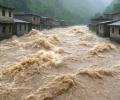
A devastating flashflood in the Kheer Ganga river on August 5 demolished nearly half of Dharali -- the key stopover en route to Gangotri with many hotels and homestays, and neighbouring Harsil, where an Army camp bore the brunt of the flood fury, barely giving time to the victims to run to safety.

Amir Rashid Ali, a key accused in the Red Fort area car bomb blast case, has been remanded in 10 days' NIA custody. The agency seeks to unravel the conspiracy behind the inter-state "white collar" terror module.
Heavy rainfall across North India leads to fatalities, structural damage, travel disruptions, and school closures. Eastern states brace for more rain.

Terror outfits in Jammu and Kashmir are now constructing elaborately-designed underground bunkers deep inside thick forests and elevated ridges instead of taking shelter in local houses, officials said. This tactical shift, fuelled by eroding local support, presents a new challenge to the Army and other security forces.
"Investigators are now tracing the route towards Daryaganj, while more than 100 CCTV clips, including footage from nearby toll plazas, are being examined to establish the complete movement of the vehicle," the sources added.

Former IAS officer Kannan Gopinathan, who resigned from service in 2019 as a mark of protest against the "shutdown" of Jammu and Kashmir following the abrogation of Article 370, joined the Congress on Monday.

Prime Minister Narendra Modi on Sunday claimed that the Congress had been unwilling to accept Tejashwi Yadav as the Indian National Developmental Inclusive Alliance (INDIA) chief ministerial candidate and relented only after the Rashtriya Janata Dal pointed a 'katta', an unlicensed country-made gun, at its head.
One of the two cases was registered by NIA's Delhi branch in 2021, and the other was lodged by the anti-terror agency's Jammu branch in 2022.
Officials reveal details of a foiled Jaish-e-Mohammed terror plot involving a doctor who planned a bomb blast near the Red Fort, timed around the Babri Masjid demolition anniversary. Arrests and investigations uncovered the interstate network.

'The terrorists are using better technology to secure their communication.' 'It does appear that excessive reliance on technology led to a weakening of human intelligence.'

They said troops foiled the infiltration bid in Churunda area of Uri in Baramulla district of north Kashmir.

A police officer and his eight siblings, including five sisters, were deported to Pakistan on Wednesday despite a court order granting them temporary relief. The nine members of the extended family, who have been living in Jammu and Kashmir for generations, were among more than two dozen people, mostly from Pakistan-occupied Kashmir (PoK), who were served deportation notices following the April 22 Pahalgam terror attack. The deportation has sparked outrage, with protests and appeals for intervention from the home minister and lieutenant governor. The family members claim they are not Pakistani nationals and have been living in the region for generations, presenting revenue records to support their claims. The court has ordered a detailed report on the case within two weeks and will hear it again on May 20.

A comprehensive risk assessment warns that Kishtwar district in Jammu and Kashmir faces a serious threat from glacial lake outburst floods (GLOFs), endangering lives, infrastructure, and the ecosystem. The report calls for immediate mitigation measures and long-term strategies to build resilience.

Ancient Hindu idols and 'Shivlings' were discovered during excavation work for the renovation of a spring in Anantnag district, Jammu and Kashmir. The site is significant for Kashmiri Pandits and is associated with the Karkoota dynasty.

The death toll in the Vaishno Devi landslide has gone up to 32, officials said on Wednesday, a day after disaster struck the route on the hilltop shrine in Jammu and Kashmir's Reasi district.

A Pakistani intruder was killed by the BSF while attempting to cross the International Border in the Kathua district of Jammu and Kashmir. The BSF is lodging a protest with Pakistani counterparts.
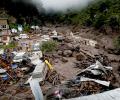
Jammu and Kashmir Chief Minister Omar Abdullah briefed Prime Minister Narendra Modi on a devastating cloudburst in Kishtwar district that claimed 60 lives and injured over 100. Abdullah expressed condolences and assured assistance, while also questioning potential administrative lapses.

Two Army soldiers were killed and two others injured in a gunfight with terrorists in Kulgam district. The anti-terror operation has entered its ninth day.

Two unidentified terrorists were killed and three soldiers injured in an encounter in Kulgam district of Jammu and Kashmir on Monday, officials said in Srinagar.

A man running a community kitchen for pilgrims was rescued alive after being trapped under debris for 30 hours following a cloudburst in Kishtwar, Jammu & Kashmir. The disaster has left many dead or missing and the annual pilgrimage suspended.
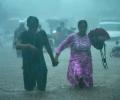
The India Meteorological Department (IMD) has predicted above-normal rainfall for most parts of India during the post-monsoon season (October to December), except for some areas in the northwest. The southwest monsoon season ended with the country recording eight per cent above normal rainfall.

Long denied the right to vote, members of the Valmiki community exercised their franchise for the first time in the Jammu and Kashmir assembly elections on Tuesday and termed it as a "historic moment".

A terrorist was killed in an encounter with security forces in the Akhal forest area of Jammu and Kashmir's Kulgam district. The encounter began after a cordon and search operation based on intelligence inputs.

The troops of these two units are expected to be based in Samba and near the Jammu-Punjab border, the sources said.

Poonch district alone accounted for 13 civilian deaths among 28 fatalities in the Pakistani shelling and drone attacks in Jammu and Kashmir after the Indian armed forces carried out missile strikes on terror infrastructure across the border under Operation Sindoor in May in retaliation to the April 22 Pahalgam terror attack that left 26 persons, mostly tourists, dead.

Jammu and Kashmir Lieutenant Governor Manoj Sinha claims a significant reduction in the fear of terrorism in the Kashmir Valley, citing increased industrial activity in Pulwama and a decline in local terror recruitment.

'The government is distributing land in Ladakh as if they are selling cinema hall tickets.'
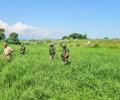
'Why have we failed to address the issue of ensuring a requisite buffer zone in J&K, given that cross-border links of some J&K politicians are known?', asks Lieutenant General Prakash Katoch (retd).

A 32-year-old man chargesheeted in the deadly terror attack on a Central Reserve Police Force (CRPF) convoy in Jammu and Kashmir's Pulwama district five years ago has died of a heart attack in the Government Medical College Hospital in Jammu, officials said.

Priyanka accused the prime minister of "speaking on unnecessary issues" while staying silent on corruption, unemployment and the alleged misrule under the NDA government in Bihar.
